Your AI operations layer. Built and operated.
We map how your operation runs, then build and operate the AI systems it needs. You start with one problem you can name today.
For growing service businesses with real operational complexity. The call is a fit conversation; the engagement it can lead to is the Operational Systems Audit, paid and fixed-scope.

You built something valuable.
Then it got complicated.
Everything that runs the business was added one piece at a time. Past a certain size, four things follow.
- Workflows are fragmented.
- Systems are disconnected.
- Knowledge lives in people.
- The AI path is unclear.
Lucent works with growing service businesses where several of these are true at once.
Build what's missing. Connect what exists. Operate it together.
Lucent works with the tools and processes your business already relies on, building new capabilities where needed and connecting the work between them.


Illustrative scenario
When a customer reaches out, Lucent connects relevant information and coordinates the next step through your existing tools.
Illustrative scenario
When work changes in one system, Lucent can coordinate updates across connected records and surface inconsistencies for review.
Illustrative scenario
When work stalls or requires approval, Lucent identifies the issue and coordinates the next authorized step with the responsible person.
Illustrative scenario
Lucent brings operational records together so leadership can see what is open, delayed, or awaiting a decision.
Not recommended. Not templated. Built.
Four stages, one path. Each ends with something you keep, whether or not the next one happens.
- Diagnose
Understand the operation and find where AI creates leverage.
Explore the Operational Systems AuditYou keepThe documented diagnosis - Design
Define the systems and what they need to know.
You keepThe system blueprint - Build
Built alongside the running business. Nothing is replaced before its replacement works.
You keepThe working system - Improve
Operate, optimize, and expand as the business changes.
You keepThe operating leverage
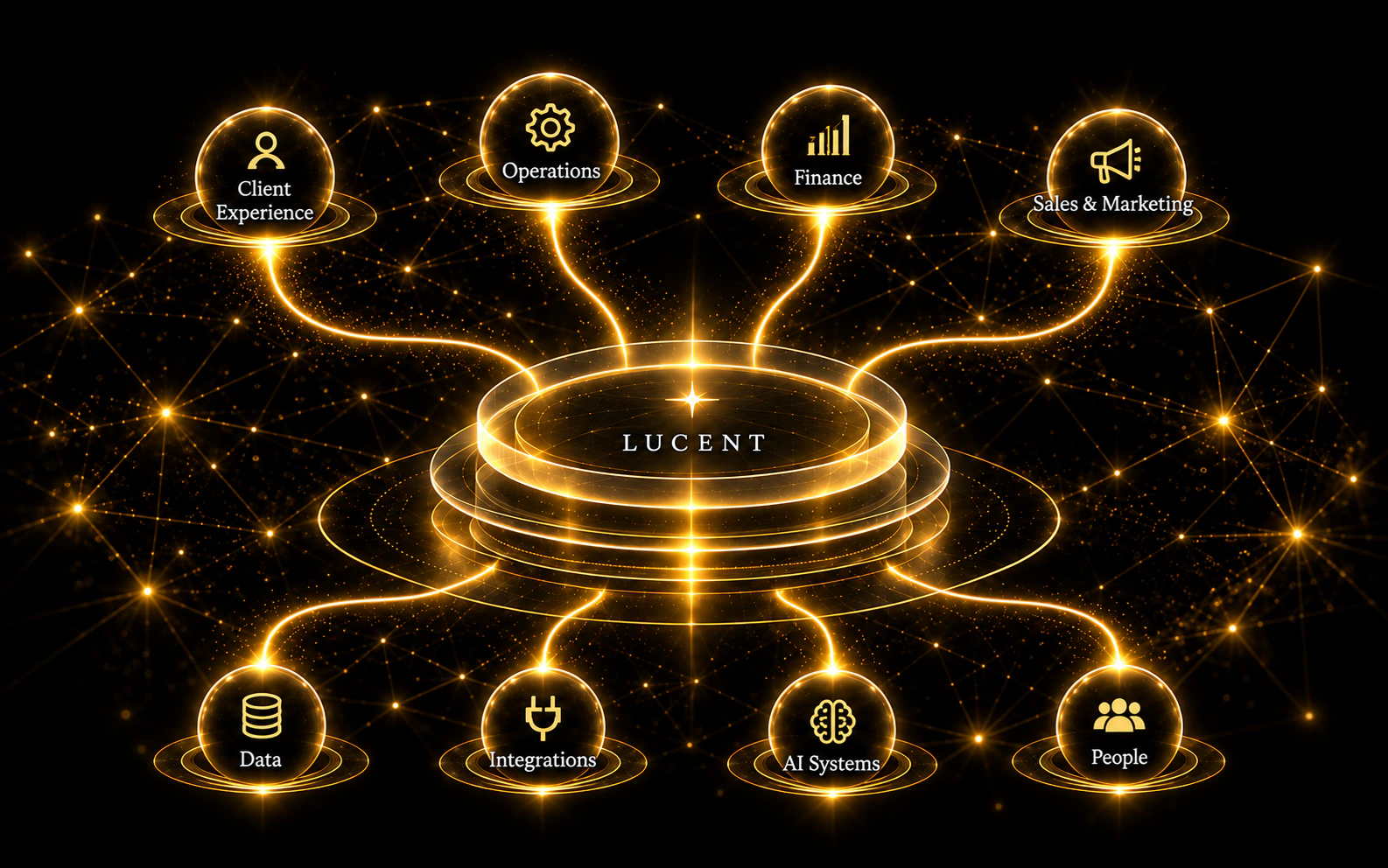

- Client Experience
- Operations
- Finance
- Sales & Marketing
- Data
- Integrations
- AI Systems
- People
One AI system solves one problem. An AI operations layer changes how the business runs.
Lucent builds systems around specific operational problems. As those systems accumulate, they share context and infrastructure, becoming a connected operating layer Lucent can continue to run and improve.
Built system by system. Operated as one.
See how Lucent operatesThe areas above illustrate where Lucent can build, connect, and operate. Each solution is scoped to your business, existing tools, and operational requirements. The layer shown here is a concept surface, not production data. Lucent publishes no measured client outcomes, and every claim on this page ties to a documented mechanism.
One method. Three scopes.
The method does not change with the engagement. Foundation, Partner, and Infrastructure differ in how much of your operation it is applied to and how much gets built each cycle, never in how the work runs.
- FoundationOne focused operational system
- PartnerAn ongoing operational systems partnership
- InfrastructureA complete custom operating environment
You know AI matters. The hard part is knowing where to begin.
A few questions business leaders ask before the work starts.
What does Lucent actually do?
We design, build, and then operate the AI systems a business runs on. The operating part is the difference: we do not stop at handoff.
What does it cost?
It starts with the Operational Systems Audit: paid, fixed-scope, and yours to keep whether or not we build together. Build cost depends on the system the audit identifies, and you see a proposal before anything is committed.
Who owns the systems?
You do. Systems are built inside your accounts and your tools wherever possible, so ownership is a fact of where they live, not a promise in a contract. Lucent usually keeps operating what it builds, but that is a service you choose, not something the system needs to function.
How does data work?
Only what a system needs to do its job, and only for as long as it needs it. Access is scoped to the work, activity is logged so you can see what happened, and we never train on your data or share it with another client.
Who is Lucent for?
Growing service businesses where coordination has become its own job: the work itself is fine, but keeping it moving takes constant handoffs, chasing, and re-explaining. If one tool still runs the whole operation cleanly, this is early for you.
How does Lucent make sure an AI system actually understands our business?
Structuring that understanding is part of the build, not a setup step before it: how decisions actually get made, the terminology specific to your operation, and the context a generic AI tool would not have.
Discuss your operating environment.
The first step is a strategy call, a short conversation about what you are running into and whether Lucent is the right builder for it. For a broader diagnosis, that is the paid Operational Systems Audit.